
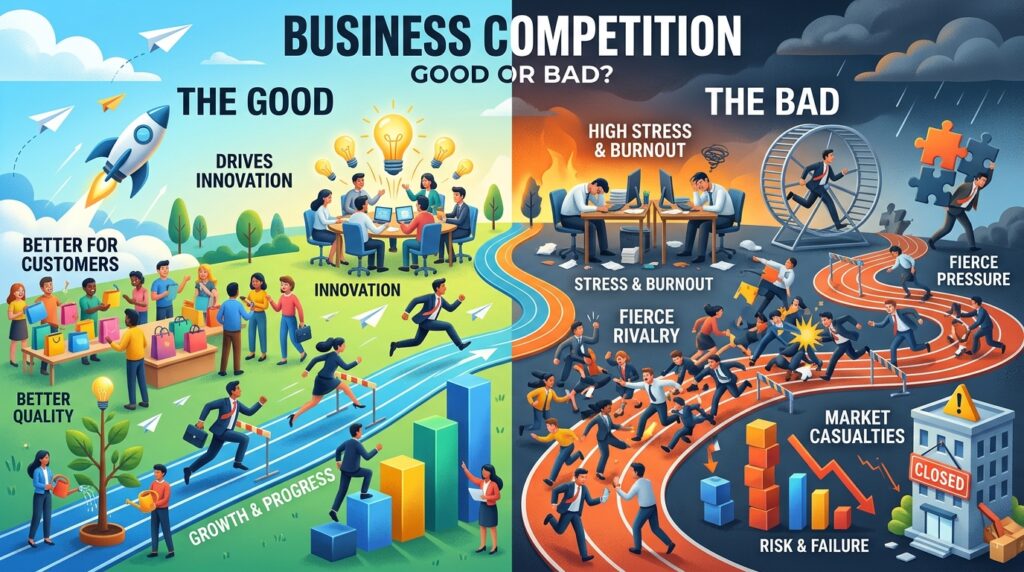

Business competition can be both good and bad, depending on how companies compete and how intense the competition becomes. Healthy competition encourages innovation, improves product quality, provides customers with more choices, and motivates businesses to become more efficient. However, excessive competition can reduce profits, increase operating expenses, create financial pressure, and make it difficult for smaller companies to survive.
In the United States, competition plays an important role in the business environment. From local restaurants and independent retailers to technology companies and major corporations, businesses constantly look for ways to attract customers and stand out in their industries.
Understanding the positive and negative effects of competition helps business owners make better decisions. It also helps consumers recognize how competition influences prices, product quality, customer service, and available choices.
What Is Business Competition?
Business competition is the process through which companies compete with other businesses to attract customers, increase sales, grow market share, and establish a stronger position in their industries.
Companies can compete in several ways, including:
- Offering competitive prices.
- Improving product quality.
- Developing innovative products and services.
- Providing better customer support.
- Creating stronger brand identities.
- Improving convenience and delivery.
- Building long-term customer relationships.
For example, two coffee shops operating in the same American neighborhood may compete by offering different drink options, affordable prices, comfortable environments, and faster service.
Although both businesses serve similar customers, each may develop a different strategy to attract and retain them.
Business competition does not always mean lowering prices. Companies can also compete through quality, convenience, reliability, customer experience, and specialized products.
Is Business Competition Good or Bad?
Business competition is generally beneficial when companies compete fairly by offering better products, services, prices, and customer experiences. It encourages businesses to improve and gives consumers more opportunities to choose products that meet their needs.
However, competition can become harmful when companies focus entirely on defeating their rivals rather than creating customer value.
For example, a company that continuously reduces prices without controlling its operating expenses may eventually struggle to pay employees, maintain inventory, or invest in future improvements.
The effects of competition depend on several factors:
- The number of competing businesses.
- Customer demand.
- Market conditions.
- Operating expenses.
- Access to financial resources.
- Product differentiation.
- The quality of business management.
- Whether competitors follow fair business practices.
Therefore, competition should not automatically be considered good or bad. Its overall impact depends on the behavior of businesses and the conditions of the market.
Advantages of Business Competition
Healthy competition offers several advantages to businesses, customers, and the broader economy. It encourages companies to improve their operations and develop products that provide meaningful value.
Here are some of the most important benefits.
1. Encourages Innovation
One of the biggest advantages of business competition is that it encourages innovation.
When several companies serve the same market, they have an incentive to develop better products, introduce useful features, and find new ways to solve customer problems.
For example, American technology companies compete by developing smartphones, software, computer equipment, and digital services with improved features and performance.
This competition gives businesses a reason to invest in research, product development, and new technologies.
Innovation can also involve improving existing services rather than creating something completely new.
A delivery company, for instance, might introduce better order tracking, more convenient delivery options, or a simpler customer experience to distinguish itself from competitors.
2. Improves Product and Service Quality
Competition motivates companies to maintain quality because customers can often choose another provider when they are dissatisfied.
Businesses that consistently provide poor products or unreliable services risk losing customers to companies that offer better experiences.
Consider two home improvement companies offering similar services.
One company provides clear estimates, uses quality materials, communicates regularly, and completes projects on schedule. The other company frequently delays projects and provides limited customer support.
Even if the second company charges less, customers may prefer the first business because reliability and service quality matter.
This demonstrates how competition can encourage companies to improve the complete customer experience.
3. Creates More Competitive Prices
Competition can encourage businesses to offer reasonable prices because customers can compare alternatives before making purchasing decisions.
When multiple companies sell similar products, businesses may need to adjust their pricing to remain attractive.
For example, grocery stores compete by offering discounts, loyalty programs, different product brands, and promotional pricing.
Customers can compare these offers and select the options that fit their budgets.
However, lower prices are not guaranteed in every market. Pricing also depends on production costs, supply conditions, customer demand, and the level of competition.
4. Increases Customer Choice
Business competition provides customers with more options.
Instead of relying on a single company, consumers may be able to choose between different brands, service providers, product features, and purchasing experiences.
For example, someone shopping for a laptop may compare several manufacturers based on:
- Price.
- Processing power.
- Battery life.
- Design.
- Warranty.
- Customer support.
- Intended use.
This variety helps consumers select products according to their individual requirements.
Businesses also benefit because different customer groups may prefer different features, prices, and service models.
5. Encourages Business Efficiency
Companies operating in competitive markets often look for ways to reduce unnecessary expenses and improve their internal processes.
Better inventory management, employee training, technology adoption, and improved customer service systems can help businesses operate more effectively.
For example, a restaurant might introduce an online ordering system to reduce ordering errors and manage customer requests more efficiently.
Improved operations can reduce waste, save time, and create a better experience for customers.
Efficiency is especially important for businesses operating with limited resources.
6. Creates Opportunities for New Businesses
Competition does not only benefit established companies. It can also create opportunities for entrepreneurs who identify customer needs that existing businesses are not addressing.
A new business may enter a market by offering:
- Specialized products.
- Personalized services.
- Better convenience.
- Local expertise.
- More flexible purchasing options.
- Solutions for underserved customer groups.
For example, a small American retailer may focus on environmentally conscious household products while larger competitors offer a broader range of general merchandise.
By serving a specific customer group effectively, the smaller company can establish its own position.
New businesses do not always need to defeat established competitors. They need to provide a compelling reason for customers to choose them.
Disadvantages of Business Competition
Although competition can improve markets, it also creates challenges. Businesses must understand these disadvantages to avoid decisions that damage their financial stability or long-term growth.
1. Reduces Profit Margins
Strong competition can make it difficult for businesses to maintain profitable prices.
When several companies offer similar products, customers may choose the least expensive option. Businesses may respond by reducing prices, offering discounts, or increasing promotional spending.
However, lower prices do not necessarily mean higher profits.
For example, imagine a hypothetical clothing retailer that sells a jacket for $100. After purchasing, shipping, and operating expenses, the retailer earns a reasonable margin.
If competitors begin selling similar jackets for significantly less, the retailer may feel pressure to reduce its price.
If expenses remain unchanged, its profit per sale decreases.
Over time, businesses that consistently sacrifice margins may struggle to cover their expenses.
2. Creates Financial Pressure
Competing effectively often requires financial investment.
Businesses may need to spend money on:
- Marketing and advertising.
- Product development.
- Employee training.
- Better equipment.
- Customer service.
- Technology.
- Inventory management.
- Distribution improvements.
Large companies may have greater financial resources to support these activities.
Smaller businesses, however, may have limited budgets and fewer opportunities to absorb unexpected expenses.
This difference can make competition particularly challenging for startups and independent businesses.
3. Can Encourage Unhealthy Price Wars
A price war happens when competing businesses repeatedly reduce prices in response to one another.
Although lower prices can attract customers, continuous price reductions can create problems when businesses cannot maintain sustainable profit margins.
For example, imagine two independent electronics retailers selling similar accessories.
The first retailer reduces its price to attract customers. The second responds with an even lower price. The first then introduces another discount.
If this pattern continues, both businesses may earn very little from each transaction.
Eventually, they may struggle to pay operating expenses or maintain product quality.
A better strategy is to compete through a combination of price, reliability, product selection, and customer experience rather than relying entirely on discounts.
4. Makes Customer Retention More Difficult
When customers have several alternatives, businesses must work harder to maintain customer relationships.
A customer may switch providers because another company offers:
- Lower prices.
- Faster delivery.
- Better customer support.
- More convenient payment options.
- Additional features.
- More attractive promotions.
This creates pressure on businesses to maintain consistent service quality.
Customer retention becomes especially important for companies that depend on repeat purchases or long-term service agreements.
Businesses that ignore customer feedback may lose customers even when their products are reasonably priced.
5. Can Increase Marketing Expenses
Businesses often spend money to distinguish their brands from competitors.
They may invest in digital advertising, social media campaigns, promotional events, sponsorships, and other marketing activities.
While marketing can help companies attract customers, excessive spending can become a financial burden.
For example, two local service providers may compete for the same customers through paid advertising.
If both continually increase their advertising budgets without measuring results, their customer acquisition costs may rise.
A better approach is to identify the most effective marketing channels and focus on attracting customers who are likely to generate sustainable revenue.
6. May Lead to Business Closures
Not every business can survive intense competitive pressure.
Companies with weak financial management, outdated products, limited customer demand, or high operating costs may struggle when stronger competitors enter their markets.
A local retail store, for example, may lose customers if shoppers increasingly prefer larger retailers with broader product selections and convenient purchasing options.
However, competition is not the only reason businesses close. Poor planning, changing consumer preferences, economic conditions, supply problems, and management decisions can also contribute.
The important point is that businesses need a sustainable strategy to respond to changing market conditions.
How Business Competition Affects Different Groups
Competition affects more than business owners. Its impact extends to consumers, employees, entrepreneurs, and the wider economy.
| Group | Potential benefits | Potential disadvantages |
|---|---|---|
| Consumers | Better prices, more choices, and improved services | Confusing options and inconsistent product quality |
| Small businesses | Opportunities to serve specialized markets | Limited resources and pricing pressure |
| Large companies | Opportunities to expand and improve efficiency | Pressure to maintain market position |
| Employees | New job opportunities and business growth | Job uncertainty when businesses struggle |
| Entrepreneurs | Opportunities to introduce new ideas | Financial risks and difficulty entering established markets |
| Economy | Innovation, productivity, and consumer benefits | Business failures and short-term economic disruption |
The overall impact depends on market conditions and how businesses respond to competitive pressure.
Healthy Competition vs. Unhealthy Competition
Not all competition creates the same results.
Healthy competition focuses on providing better value to customers. Unhealthy competition focuses on gaining an advantage through unsustainable or unfair practices.
Understanding the difference helps business owners make better decisions.
| Healthy competition | Unhealthy competition |
|---|---|
| Improving product quality | Misleading customers |
| Offering fair prices | Unsustainable price wars |
| Investing in innovation | Copying competitors without adding value |
| Improving customer service | Spreading false information about rivals |
| Building brand trust | Using deceptive marketing |
| Improving efficiency | Sacrificing essential quality |
| Developing better products | Attempting to undermine competitors unfairly |
Healthy competition gives businesses incentives to improve while respecting customers and competitors.
Unfair or deceptive business practices can damage consumer trust and may create legal problems.
In the United States, federal antitrust laws address certain anticompetitive conduct, including unlawful price-fixing agreements and monopolization. Businesses should not assume that every aggressive competitive strategy is legally acceptable.
Examples of Business Competition in the United States
Business competition can be observed across almost every major American industry.
The following hypothetical scenarios demonstrate how companies may compete and how that competition can produce different outcomes.
1. Competition Between Grocery Stores
Grocery stores compete through product selection, pricing, convenience, store locations, and customer loyalty programs.
One retailer may focus on affordable everyday products, while another may emphasize organic food, specialty items, and premium customer service.
Consumers benefit when these options provide meaningful differences and competitive value.
However, grocery retailers must also manage inventory expenses, staffing costs, and supply conditions to remain profitable.
2. Competition in the Technology Industry
Technology companies compete by developing new features, improving software, strengthening security, and providing better user experiences.
For example, smartphone manufacturers may compete through camera performance, battery life, processing speed, and device design.
This encourages ongoing product development.
At the same time, technology companies must balance innovation expenses with customer demand and long-term financial sustainability.
3. Competition Between Restaurants
Restaurants compete through food quality, menu variety, pricing, atmosphere, convenience, and service.
A small neighborhood restaurant may attract customers through personalized service and distinctive recipes.
A larger restaurant chain may compete through consistent menus, convenient locations, and established brand recognition.
Both businesses can succeed by understanding their target customers and delivering experiences that match their expectations.
4. Competition in Online Retail
Online retailers compete through website usability, product selection, shipping options, return policies, and customer support.
A smaller online store may not be able to match the resources of a major retailer.
However, it may attract customers by specializing in a particular product category, providing detailed product information, or offering personalized assistance.
The lesson is that businesses can compete through differentiation instead of relying exclusively on lower prices.
How Small Businesses Can Compete Effectively
Small businesses often face challenges when competing against larger organizations. They may have smaller budgets, fewer employees, and limited access to resources.
However, a smaller company can still build a competitive position by focusing on areas where it can deliver meaningful value.
Here are practical strategies.
1. Identify Your Target Customers
Start by understanding the people most likely to purchase your products or services.
Consider their:
- Needs and preferences.
- Purchasing behavior.
- Budget.
- Common problems.
- Expectations.
- Reasons for choosing one provider over another.
A clear understanding of your audience helps you create products and marketing messages that address real customer needs.
2. Research Your Competitors
Competitor research helps businesses understand the market and identify opportunities for improvement.
Study competing companies to understand:
- What products or services they offer.
- How they position their brands.
- What customers appreciate about them.
- Where customers experience problems.
- How they communicate their value.
- What makes their offers different.
The purpose of competitor research is not to copy another company. It is to identify opportunities to serve customers more effectively.
3. Develop a Unique Selling Proposition
A unique selling proposition explains why customers should choose your business instead of another available option.
Your business might differentiate itself through:
- Specialized expertise.
- Personalized customer service.
- Faster response times.
- Unique product features.
- Convenient ordering.
- Flexible service packages.
- Strong product knowledge.
For example, a small accounting firm may focus on helping independent contractors and local businesses instead of trying to serve every type of client.
This specialization can make its services more relevant to its target audience.
4. Focus on Customer Experience
Customer experience can become an important competitive advantage.
Respond to customer questions promptly, explain products clearly, address complaints professionally, and make purchasing convenient.
Businesses should also collect feedback to understand what customers appreciate and where improvements are necessary.
Consistent service can help build trust and encourage repeat business.
5. Manage Your Pricing Carefully
Do not automatically reduce prices whenever a competitor introduces a discount.
Before changing prices, calculate:
- Product or service costs.
- Operating expenses.
- Desired profit margin.
- Customer demand.
- Competitor pricing.
- The value customers receive.
A business can justify a higher price when it offers meaningful additional value.
The objective should be sustainable profitability rather than simply becoming the cheapest option in the market.
6. Use Marketing Strategically
Marketing helps businesses communicate their value and reach potential customers.
Small companies can consider:
- Search engine optimization.
- Local search visibility.
- Social media marketing.
- Email marketing.
- Customer referral programs.
- Helpful educational content.
- Community partnerships.
Rather than spending money across every marketing channel, businesses should prioritize the channels that reach their intended audience and produce measurable results.
7. Continue Improving Your Products and Services
Customer expectations and market conditions change.
Businesses should regularly review their products, services, internal processes, and customer feedback.
Small improvements can make a meaningful difference over time.
For example, a local home improvement company might introduce clearer project estimates, better scheduling, and more frequent customer updates.
These changes can improve the customer experience without requiring the company to compete entirely on price.
How to Determine Whether Competition Is Helping or Hurting a Business
Business owners should evaluate competition using financial and customer-related indicators rather than relying only on sales volume.
Consider monitoring the following measurements:
| Business measurement | What it helps you understand |
|---|---|
| Gross profit margin | Whether sales generate enough money after direct costs |
| Customer acquisition cost | How much it costs to attract a new customer |
| Customer retention rate | Whether customers continue purchasing |
| Average order value | How much customers spend per transaction |
| Customer satisfaction | Whether products and services meet expectations |
| Operating expenses | Whether business costs remain manageable |
| Market share | How the business performs relative to its market |
| Repeat purchase rate | Whether customers return for additional purchases |
These measurements should be considered together.
For example, increasing sales may appear positive, but if marketing costs and discounts increase faster than revenue, the business may become less profitable.
Similarly, a business with a smaller market share may still be financially healthy if it serves a profitable niche.
The most useful question is not simply whether a company is winning against competitors. It is whether the company is building a sustainable business while providing value to customers.
Common Mistakes Businesses Make When Facing Competition
Competition can encourage better decisions, but it can also lead to mistakes when companies react emotionally or focus too heavily on their rivals.
Here are several common mistakes to avoid.
1. Competing only on price
Constant discounts can reduce profitability and make customers focus exclusively on cost.
2. Copying competitors
Copying another company’s products or marketing strategy does not necessarily address your customers’ actual needs.
3. Ignoring customer feedback
Businesses that fail to listen to customers may overlook problems that competitors are already solving.
4. Spending too much on advertising
Marketing expenses should be evaluated based on their contribution to customer acquisition and revenue.
5. Ignoring financial performance
Revenue growth is not enough if expenses increase faster than income.
6. Trying to serve everyone
A business that targets every possible customer may struggle to develop a clear market position.
7. Treating competitors as enemies
Competitors are useful sources of market information. Businesses should focus on improving their own value rather than constantly reacting to rivals.
12. Frequently Asked Questions
1. Is business competition good or bad for the economy?
Business competition is generally beneficial for the economy because it encourages companies to improve efficiency, develop new products, and offer better value. It can also increase consumer choice. However, unfair competitive practices and severe market disruptions can create negative consequences for businesses and workers.
2. Why is competition important in business?
Competition is important because it motivates companies to improve their products, services, pricing, and customer experiences. It also helps businesses identify market opportunities and understand changing customer expectations.
3. What are the biggest advantages of business competition?
The main advantages include innovation, improved quality, competitive pricing, greater consumer choice, operational efficiency, and opportunities for new businesses to enter the market.
4. What are the main disadvantages of business competition?
The main disadvantages include reduced profit margins, higher marketing expenses, financial pressure, customer retention challenges, price wars, and the possibility that weaker businesses may close.
5. Can too much competition hurt small businesses?
Yes. Intense competition can create challenges for small businesses with limited financial resources. They may struggle to match large companies’ prices, advertising budgets, and distribution capabilities. However, specialization, personalized service, and strong customer relationships can help smaller companies establish a sustainable position.
6. Does competition always lead to lower prices?
No. Competition can encourage lower prices, but actual pricing depends on production expenses, supply, demand, market structure, and other business conditions. Companies may also compete through product quality, convenience, customer service, and innovation.
7. What is the difference between healthy and unhealthy competition?
Healthy competition involves improving products, services, prices, and customer experiences through fair business practices. Unhealthy competition may involve deceptive marketing, unsustainable price wars, or attempts to undermine rivals unfairly.
8. How can a business succeed in a competitive market?
A business can improve its chances of success by understanding its target audience, researching competitors, offering distinctive value, managing expenses, maintaining product quality, and building strong customer relationships.
13. Conclusion: Is Business Competition Good or Bad?
So, is business competition good or bad?
The answer depends on how competition works and how businesses respond to it.
Healthy competition is generally good for businesses and consumers because it encourages innovation, improves product quality, creates more choices, and motivates companies to operate efficiently.
However, excessive competitive pressure can create financial challenges, reduce profit margins, increase marketing expenses, and make it harder for smaller businesses to survive.
For business owners, the best approach is to focus on sustainable growth rather than trying to defeat every competitor. Understanding customers, offering meaningful value, managing costs, and maintaining service quality can help companies build a strong market position.
Competition should encourage businesses to become better, not simply cheaper. Companies that understand this distinction are better positioned to create lasting customer relationships and operate successfully in changing markets.
Explore More: AI Appliance for Business Zanus: A Complete Guide to Private Business AI