
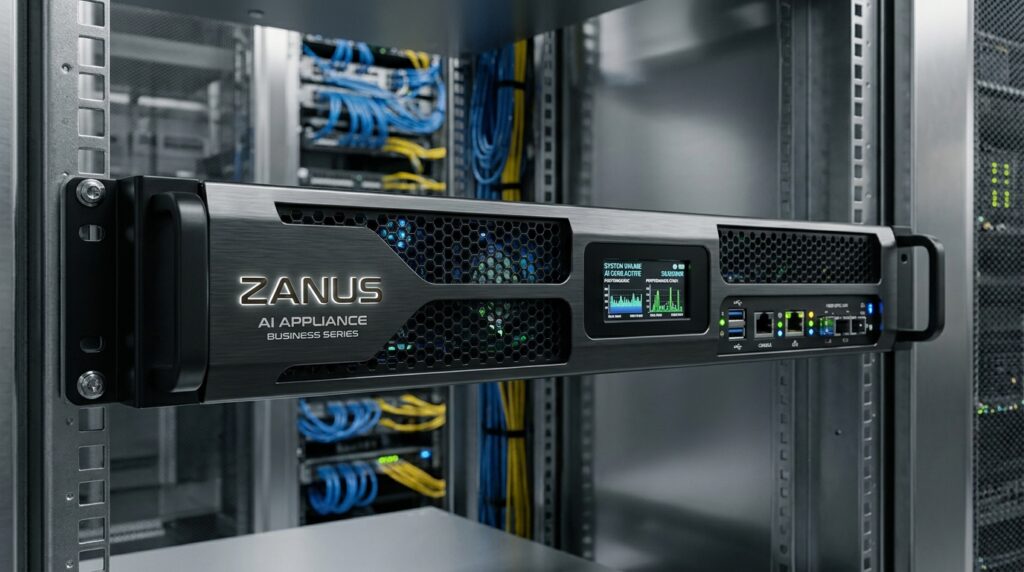

Businesses are increasingly exploring artificial intelligence to improve productivity, manage information, automate repetitive tasks, and support better decisions. However, many organizations also have concerns about sending confidential business information to external cloud platforms. An AI appliance for business, such as the system offered by Zanus AI, provides an alternative approach by combining AI hardware and software in a private, locally managed environment.
Zanus AI describes its solution as an integrated private AI system designed to help organizations use artificial intelligence with greater control over their business information. Rather than depending entirely on external AI services, the platform is designed to run AI models on dedicated hardware within a company’s own premises.
For business owners, IT managers, and enterprise decision-makers, understanding this technology is important before investing in a new AI infrastructure. This guide explores what a business AI appliance is, how Zanus AI works, its potential applications, its advantages, and the factors organizations should evaluate before choosing a private AI solution.
What Is an AI Appliance for Business?
An AI appliance for business is a dedicated hardware and software system designed to run artificial intelligence applications for an organization. Unlike ordinary computers, these systems are configured to support AI workloads, including language processing, document analysis, information retrieval, and workflow automation.
An AI appliance may include several integrated components:
- AI processing hardware: Specialized processors and graphics processing units (GPUs) that handle AI calculations.
- AI models: Large language models that interpret questions, analyze information, and generate responses.
- Data storage: Storage infrastructure for business documents, databases, and operational information.
- Vector database: A system that helps retrieve relevant information based on meaning rather than relying only on exact keyword matches.
- Business software: Applications that connect AI capabilities with everyday organizational processes.
- Administrative controls: Tools for managing access, users, configurations, and information.
The main purpose is to give organizations a dedicated environment for operating AI applications.
For example, a company could use an AI appliance to search internal policies, summarize business documents, assist employees with customer inquiries, or retrieve information from an approved knowledge base.
The exact capabilities depend on the hardware configuration, AI models, software, integrations, and implementation.
What Is Zanus AI?
Zanus AI is a technology company focused on private, on-premises artificial intelligence systems for businesses and organizations.
Its product approach combines physical AI servers, software, language models, and business applications into an integrated solution. The company describes its platform as a turnkey AI operating system, meaning the hardware and software are designed to work together rather than requiring an organization to assemble every component independently.
Zanus AI positions its technology around several central ideas:
- Private AI infrastructure.
- Locally processed business information.
- Integrated AI hardware and software.
- Business knowledge retrieval.
- Workflow and operational automation.
- Reduced dependence on external cloud AI services.
The company describes its systems as suitable for different types of organizations, including businesses, professional services, healthcare environments, educational institutions, legal organizations, and government-related operations.
One important distinction is that Zanus AI is not a traditional household appliance manufacturer. It operates in the business technology and artificial intelligence infrastructure sector.
Its private AI appliance is intended to support organizational workflows rather than perform ordinary household tasks.
How Does the Zanus AI Appliance Work?
The basic idea behind a private AI appliance is to bring AI processing closer to the organization that uses it.
Instead of sending every request to an external cloud AI provider, the system processes supported AI workloads using its own configured hardware and software.
The general workflow involves several stages.
1. AI Hardware Processes Information
The appliance contains dedicated computing hardware designed to run AI models.
Zanus AI describes its systems as incorporating enterprise GPUs and built-in AI models. These components provide the processing capacity needed for supported AI tasks.
The hardware configuration determines which models can run, how quickly requests can be processed, and how many users or workloads the system can support.
2. Business Knowledge Is Organized
Organizations often have valuable information spread across different documents, databases, policies, manuals, and internal records.
A private AI system can organize approved information into a searchable knowledge environment.
For example, a company might include:
- Employee handbooks.
- Product documentation.
- Customer service procedures.
- Internal operating policies.
- Technical manuals.
- Training materials.
- Approved business reports.
Zanus AI describes using a precision vector store to help its AI retrieve relevant information from organizational knowledge.
This approach is related to retrieval-augmented generation (RAG), a technique that allows an AI model to retrieve relevant information from an external knowledge collection before generating an answer.
3. Employees Ask Questions
Once the information is configured, authorized employees can interact with the AI system through its supported interface.
For example, an employee might ask:
“What is our current procedure for processing a customer refund?”
The AI system can search the configured business knowledge and generate an answer based on relevant information.
The quality of the response depends on the accuracy of the source documents, retrieval configuration, model capabilities, and system settings.
4. AI Supports Business Workflows
Beyond answering questions, business AI systems can support operational activities.
Depending on the software modules and integrations available, these activities may include document processing, customer support assistance, information management, and task automation.
The purpose is to connect AI with practical business processes instead of limiting its use to a general-purpose chatbot.
Main Features of the Zanus AI Business Appliance
Zanus AI presents its technology as a combination of dedicated hardware and business software. Understanding the main components helps organizations evaluate whether the platform matches their requirements.
Private On-Premises AI Processing
One of the main features promoted by Zanus AI is on-premises processing.
On-premises means that the hardware and software operate within an organization’s own physical environment or controlled infrastructure.
This arrangement can be useful for businesses that want greater control over where their information is processed and stored.
For example, a legal office may want its internal document analysis to take place on infrastructure under its own management.
However, local processing alone does not guarantee complete security. Organizations must also configure user permissions, network protection, encryption, backups, and system updates appropriately.
Built-In AI Models
Zanus AI describes its appliances as including multiple large language models.
A large language model is an AI system trained to understand and generate human language. It can support activities such as answering questions, summarizing documents, drafting text, and analyzing information.
Having models available locally can reduce the need to send every prompt to an external AI service.
However, model availability, performance, context limits, and supported tasks depend on the specific system configuration.
Precision Vector Store
A vector store helps an AI application locate relevant information within a collection of documents.
Traditional searches often depend on matching exact words. Vector-based retrieval can identify content with similar meaning, even when the wording is different.
For example, an employee searching for “employee vacation rules” might retrieve a company document titled “Paid Time Off Policy.”
This capability can make internal information easier to find.
It is especially relevant to organizations that manage large document collections and want employees to access approved information more efficiently.
Integrated Business Software
An AI appliance becomes more useful when its capabilities connect with everyday business operations.
Zanus AI describes its platform as including business-oriented software modules rather than providing only a physical server.
Depending on the selected software configuration, applications may support:
- Customer service operations.
- Document management.
- Internal knowledge retrieval.
- Business workflow automation.
- Reporting and analysis.
- Task management.
- Information organization.
Businesses should confirm exactly which modules are included in their selected package before purchasing.
Local Network Access
A locally hosted AI appliance can allow authorized employees to access AI applications through an organization’s internal network.
This can be useful for offices where several departments need access to a shared AI environment.
For example, employees in customer support, administration, and operations may use the same approved knowledge base while working with different permissions.
The actual number of simultaneous users and supported workloads depends on system capacity.
Reduced Dependence on External AI Services
Traditional cloud AI services process requests using infrastructure managed by external providers.
A private AI appliance offers another deployment model by running supported models locally.
Zanus AI promotes its platform as operating without cloud AI dependencies or per-token usage charges.
Organizations should still review licensing, maintenance, hardware support, electricity, software updates, and any separately priced services when calculating the complete cost.
How Can Businesses Use Zanus AI?
The value of a business AI appliance depends on how effectively it supports real organizational needs.
Here are several practical areas where private AI infrastructure may be useful.
1. Customer Service and Support
Customer service teams regularly handle questions about products, services, orders, returns, policies, and technical problems.
An AI system connected to an approved knowledge base can help employees locate relevant information and prepare responses.
Potential applications include:
- Searching customer support documentation.
- Summarizing support conversations.
- Helping agents understand company procedures.
- Organizing customer inquiries.
- Supporting ticket classification and routing.
- Retrieving product information.
For organizations handling confidential customer records, local processing may provide an additional layer of control over information flows.
However, customer-facing automation should be tested carefully. Incorrect answers, misunderstood requests, and complex complaints may still require human assistance.
2. Legal Offices and Professional Services
Law firms and professional service organizations work with documents that may contain sensitive business or client information.
A private AI system could help authorized employees search internal documents, summarize approved materials, and locate relevant information.
Potential use cases include:
- Internal document searches.
- Contract information retrieval.
- Policy research within approved records.
- Document summarization.
- Administrative assistance.
AI-generated legal information should never automatically replace professional judgment or qualified legal review.
Law firms should also evaluate confidentiality obligations, access permissions, retention policies, and applicable professional requirements.
3. Healthcare Organizations
Healthcare providers manage operational documents, administrative procedures, patient-related workflows, and internal policies.
A properly configured private AI environment may assist with administrative information retrieval and internal documentation tasks.
Possible applications include:
- Searching approved operational policies.
- Retrieving internal training information.
- Summarizing administrative documents.
- Supporting staff knowledge management.
- Organizing non-clinical workflows.
Healthcare organizations must pay particular attention to patient privacy and applicable regulatory requirements.
Installing an on-premises AI appliance does not automatically make an organization HIPAA compliant. The complete environment, including software, access controls, vendors, data handling, and operational procedures, must be evaluated.
AI should not independently make clinical decisions without appropriate clinical oversight and regulatory review.
4. Manufacturing and Industrial Operations
Manufacturing companies manage technical documentation, equipment instructions, maintenance procedures, safety materials, and production information.
An AI appliance connected to approved documentation could help employees retrieve relevant information more quickly.
For example, a maintenance technician might ask where to find the approved inspection procedure for a particular machine.
Potential uses include:
- Equipment documentation searches.
- Maintenance knowledge management.
- Internal troubleshooting assistance.
- Technical document summarization.
- Operational procedure retrieval.
- Employee training support.
AI-generated instructions should be checked against approved technical procedures, particularly when equipment safety is involved.
5. Education and Training
Schools, training centers, and educational organizations maintain course materials, administrative information, training guides, and internal policies.
A private AI platform could support internal information retrieval and administrative assistance.
Examples include:
- Finding course documentation.
- Summarizing internal training materials.
- Answering employee policy questions.
- Organizing educational resources.
- Supporting administrative workflows.
Institutions should establish appropriate access controls and rules for handling student information.
6. Finance and Business Administration
Financial organizations and business administration teams work with reports, policies, internal records, and operational documents.
A private AI environment may help employees locate approved information and summarize internal materials.
Possible applications include:
- Searching internal financial procedures.
- Summarizing business reports.
- Retrieving compliance documentation.
- Organizing administrative records.
- Supporting internal knowledge management.
AI-generated financial analysis should be reviewed by qualified personnel before being used for important decisions.
Benefits of Using a Private AI Appliance for Business
A private AI appliance can provide several advantages, depending on the organization’s requirements and implementation.
Greater Control Over Business Information
One potential advantage of on-premises AI is that organizations can maintain greater control over their infrastructure and information flows.
Rather than automatically sending supported AI requests to an external cloud provider, the business can configure processing within its own environment.
This may be particularly valuable for organizations handling confidential documents, proprietary business information, or sensitive internal records.
Nevertheless, businesses must verify whether all components, integrations, backups, and external connections operate within their intended security boundaries.
More Predictable AI Usage Costs
Cloud AI platforms commonly use subscription, per-user, or usage-based pricing.
As usage increases, ongoing expenses may change.
A privately owned AI appliance can offer a different financial model by combining an initial hardware investment with separately managed operational expenses.
Zanus AI promotes a model without per-token or per-seat charges for its private systems.
However, owning the hardware does not mean operating it is completely free. Electricity, cooling, maintenance, staffing, upgrades, warranties, and software licensing should all be considered.
Improved Access to Internal Knowledge
Employees sometimes spend considerable time searching through documents and asking colleagues for information.
A properly configured AI knowledge system can make approved organizational information easier to retrieve.
For example, a new employee could search for onboarding procedures, internal policies, or department documentation without manually opening multiple files.
This may improve knowledge sharing and reduce repetitive administrative work.
Greater Infrastructure Independence
A local AI appliance can reduce dependence on external cloud AI infrastructure for supported workloads.
This may be helpful for organizations that prefer to control their own technology environment or have limited internet connectivity.
However, businesses should verify whether system activation, licensing, updates, remote support, integrations, and other functions require an internet connection.
Potential Workflow Improvements
AI can assist with repetitive tasks involving information retrieval, summarization, classification, and document handling.
When these functions are integrated into existing workflows, employees may spend less time on routine information management.
The actual productivity improvement depends on the quality of implementation, employee adoption, and suitability of the selected tasks.
Private AI Appliance vs. Cloud AI: What Is the Difference?
Private AI appliances and cloud AI platforms both provide access to artificial intelligence, but their infrastructure and management models are different.
| Comparison | Private AI Appliance | Cloud AI |
|---|---|---|
| Infrastructure | Dedicated local hardware | External cloud infrastructure |
| Data processing | Designed for local processing | Generally processed by a cloud provider |
| Initial investment | May require substantial hardware spending | Often lower initial infrastructure cost |
| Pricing | Hardware and operational expenses | Subscription or usage-based pricing |
| Internet dependency | May support local operation | Usually requires internet access |
| Maintenance | Managed by the organization or its provider | Much of the infrastructure is provider-managed |
| Customization | Depends on installed models and configuration | Depends on provider features and available APIs |
| Scalability | May require hardware expansion | Often easier to scale through provider resources |
| Data control | Greater direct infrastructure control | Depends on provider policies and configuration |
Which Option Is Better for a Business?
There is no universal answer.
A private AI appliance may be more suitable for an organization that needs local processing, predictable infrastructure ownership, and greater control over sensitive business information.
Cloud AI may be more practical for companies that want rapid deployment, flexible computing resources, minimal hardware management, or access to frequently updated hosted models.
Some organizations may benefit from a hybrid approach that uses private infrastructure for sensitive workloads and cloud services for less sensitive applications.
The best decision depends on security requirements, budget, technical resources, and the organization’s long-term AI strategy.
Who Should Consider the Zanus AI Appliance?
Zanus AI may be worth evaluating for organizations interested in combining AI hardware and software within a private business environment.
Potentially relevant organizations include:
Small and medium-sized businesses: Companies looking to organize internal information and introduce AI-assisted workflows without building an entire infrastructure independently.
Legal and professional firms: Organizations that need carefully managed access to confidential documents and internal knowledge.
Healthcare organizations: Providers exploring private AI infrastructure for appropriate administrative and information-management applications.
Manufacturing companies: Businesses that want to make technical documentation and operational knowledge easier to retrieve.
Educational institutions: Organizations interested in internal knowledge management and administrative assistance.
Larger enterprises: Companies with multiple departments, locations, and more complex AI infrastructure requirements.
However, not every organization needs a dedicated AI appliance. A business with limited AI usage may find a cloud-based service or smaller local deployment more economical.
Important Factors to Check Before Purchasing Zanus AI
Choosing an AI appliance is a significant technology decision. Businesses should evaluate the following factors before committing to a purchase.
1. Hardware Specifications
Review the technical specifications of the proposed system.
Important details include:
- GPU models and available memory.
- Processor specifications.
- System RAM.
- Storage capacity.
- Network connectivity.
- Cooling requirements.
- Power consumption.
- Expected hardware lifespan.
These specifications help determine whether the appliance can handle the organization’s intended workloads.
2. AI Model Capabilities
Ask which AI models are included and what tasks they support.
Important questions include:
- Which language models are available?
- Can the organization use different models for different tasks?
- What are the context-window limits?
- Can models be updated or replaced?
- What languages are supported?
- How are model responses evaluated?
The answers will help determine whether the system meets practical business requirements.
3. Data Security and Access Controls
A private AI appliance still needs proper security management.
Before purchasing, review:
- User authentication.
- Role-based access controls.
- Data encryption.
- Network security.
- Backup procedures.
- Audit logging.
- Data retention policies.
- Software update procedures.
Businesses should also ask how remote support and system maintenance are handled.
4. Software Integrations
An AI appliance is more useful when it can work with existing business tools.
Ask whether the system supports the organization’s current applications, such as customer relationship management platforms, helpdesk systems, document repositories, and internal databases.
Also verify whether integrations require additional licensing or customization.
5. Total Cost of Ownership
Do not evaluate the appliance based only on its purchase price.
Calculate the full cost over the expected operating period.
Consider:
- Hardware purchase.
- Software licensing.
- Installation and configuration.
- Electricity and cooling.
- Maintenance.
- Technical support.
- Hardware replacement.
- Employee training.
- Integration expenses.
Comparing these costs with cloud AI alternatives can provide a more realistic financial picture.
6. Customer Support and Warranty
A business-critical AI system needs reliable technical support.
Ask about warranty coverage, hardware replacement procedures, response times, software updates, and long-term maintenance arrangements.
A clear support agreement can reduce operational uncertainty.
7. Testing Through a Demonstration
Before making a purchase, request a product demonstration.
Test the system with realistic business questions and approved sample documents.
Evaluate:
- Response accuracy.
- Document retrieval quality.
- Speed.
- Ease of use.
- User permissions.
- Integration capabilities.
- Performance with multiple users.
A demonstration can help identify differences between advertised features and the organization’s actual requirements.
Potential Limitations of Business AI Appliances
Although private AI hardware offers useful capabilities, it also comes with practical limitations.
Higher Initial Investment
Unlike many cloud AI services, a dedicated appliance may require a substantial upfront investment.
Businesses must determine whether their expected usage justifies purchasing and maintaining physical hardware.
Hardware Capacity
AI performance depends heavily on hardware resources.
A system with limited GPU memory or storage may struggle with large models, complex workloads, or high numbers of simultaneous requests.
Organizations should select configurations based on realistic usage requirements.
Technical Management
Even turnkey systems require ongoing management.
Businesses need appropriate processes for backups, access management, security updates, hardware monitoring, and troubleshooting.
Some organizations may need external technical support to maintain the environment.
AI Accuracy Is Not Guaranteed
Private AI systems can still generate incorrect information.
Large language models may misunderstand questions, overlook important context, or produce answers that sound convincing but are inaccurate.
A vector database can help retrieve relevant documents, but it does not eliminate every possible AI error.
Human review remains important for legal, medical, financial, safety-related, and other high-impact decisions.
Compliance Requires More Than Local Hosting
Keeping data on local hardware does not automatically satisfy every legal or regulatory requirement.
Organizations must evaluate their complete technology environment, including data access, encryption, retention, audit controls, vendor arrangements, and operational procedures.
This is particularly important for businesses subject to healthcare, financial, privacy, or contractual obligations.
How to Evaluate Whether Zanus AI Fits Your Business
A practical evaluation process can help prevent unnecessary technology spending.
Step 1: Identify your business problem.
Determine whether your organization needs better document searches, customer support assistance, workflow automation, or private AI processing.
Step 2: Estimate usage requirements.
Identify how many employees will use the system, which departments need access, and how frequently AI applications will be used.
Step 3: Review the available configuration.
Compare the hardware, software modules, models, storage, and integration capabilities offered in the proposed package.
Step 4: Assess privacy and compliance requirements.
Determine what information the system will process and which security controls your organization needs.
Step 5: Calculate the total cost.
Include purchase expenses, operational costs, maintenance, and employee training.
Step 6: Request a demonstration.
Test practical business scenarios rather than relying exclusively on product descriptions.
Step 7: Start with a defined use case.
Where possible, begin with a limited project, measure its performance, and expand only after confirming that the system delivers practical value.
This approach allows decision-makers to compare the technology against actual organizational needs rather than purchasing AI hardware simply because it is available.
Explore more: New Jersey Business Lookup: How to Search Business Records, Verify a Company, and Find Business Information in New Jersey