
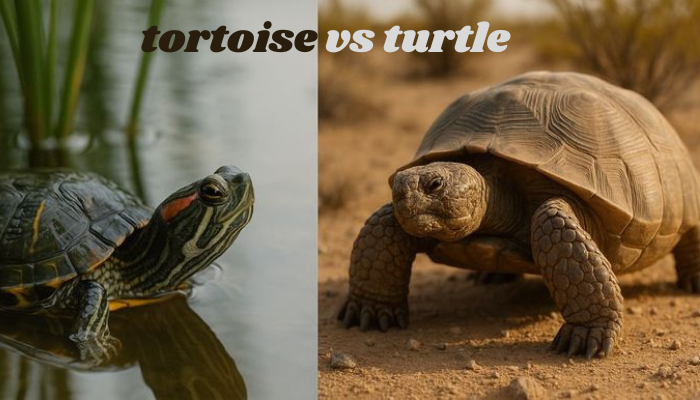

Tortoise vs turtle are exclusively terrestrial animals. They spend their entire lives on land, never venturing into water except perhaps for occasional drinking or bathing. You’ll find tortoises in grasslands, deserts, savannas, and forests across Africa, Asia, Europe, and the Americas. The Galápagos tortoise, the African spurred tortoise, and the Hermann’s tortoise all represent different terrestrial niches where these land-dwelling reptiles thrive.
This habitat distinction isn’t simply where they prefer to be. It’s encoded into their very biology. Every anatomical feature, every behavioral pattern, and every survival strategy stems from this fundamental environmental difference.
Physical Features That Reveal Their Lifestyle
When you look at a tortoise’s shell, you’re seeing a home designed for life on solid ground. Tortoise shells are typically domed and heavy, providing protection from predators and the elements. Their legs are thick, pillar-like, and positioned directly beneath their bodies, creating a sturdy stance perfect for walking across dry land. Think of a tortoise’s body plan as built for stability and protection in an open terrestrial environment.
Another observable difference appears in the head and neck region. Tortoises often have stockier heads and shorter necks adapted for reaching nearby vegetation. Many aquatic turtles, particularly freshwater species, have longer necks that extend considerably, allowing them to reach food sources while maintaining position in water and to breathe at the surface without fully emerging.
How They Move Through Their Worlds
Movement patterns reveal perhaps the most obvious difference between tortoises and turtles. Watch a tortoise move, and you’ll observe a deliberate, steady pace. Some might characterize it as slow, though certain species like the spurred tortoise can reach surprising speeds across open terrain. Their movement style reflects their terrestrial existence, where energy efficiency on solid ground matters more than speed.
This difference in locomotion becomes particularly important when considering their vulnerability. A tortoise on land is in its element, moving with purpose and confidence. A turtle on land is essentially displaced, moving awkwardly and exposing itself to greater danger. This explains why sea turtles spend minimal time on beaches, coming ashore only to nest, and why freshwater turtles rarely stray far from water.
What Goes Into Their Mouths
The diets of tortoise vs turtle and turtles diverge significantly based on their environments and available food sources. This dietary difference extends to how they hunt, what nutrition they require, and even how long they can survive without food.
Tortoises are primarily herbivorous creatures. Most species spend their days grazing on grasses, leafy vegetation, cacti, and other plants. The African tortoise browses on various shrubs and grasses, while some Mediterranean tortoises seek out specific flowering plants. This herbivorous diet means tortoises have evolved long digestive processes to extract maximum nutrition from plant matter. A tortoise’s jaw structure and digestive system are built around processing tough, fibrous vegetation.
This dietary flexibility gives many turtle species advantages in varying environmental conditions. When food availability changes seasonally, turtles can adjust their diet more readily than tortoises, which remain committed to plant-based nutrition.
How Long Can They Actually Live
Both tortoises and turtles are celebrated for their longevity, but even their lifespans tell different stories.
Tortoises are among tortoise vs turtle. Giant Galápagos tortoises regularly reach ages exceeding 100 years, with some individuals living well into their 150s. Even smaller tortoise species commonly reach 50 to 80 years old. This incredible longevity reflects their slow metabolism, terrestrial lifestyle, and reproductive strategy. A human might need to make a lifetime commitment to caring for a pet tortoise.
While these lifespans often overlap, the general pattern shows tortoises pushing the upper limits of reptilian longevity. Their slower pace of life, reduced predation, and protected terrestrial existence contribute to these extended years.
Reproductive Strategies and Nesting
Despite both being egg-laying reptiles, tortoises and turtles approach reproduction differently. These strategies reflect their environmental realities and survival pressures.
Tortoises typically lay smaller numbers of larger eggs. A female tortoise might produce anywhere from one to thirty eggs depending on the species, but she often lays only a few clutches in her lifetime. These eggs are deposited in burrows or holes dug in the soil, where they incubate protected underground. The hatchlings must dig upward through soil to reach the surface, a process that can take considerable energy and time.
Interestingly, both tortoise vs turtle rely on temperature to determine offspring sex. The temperature during egg incubation determines whether hatchlings develop as male or female, meaning climate change poses significant threats to both groups.
Behavioral Differences That Shape Their Daily Lives
If you spent a day observing a tortoise versus observing a turtle, you’d witness remarkably different daily routines and behavioral patterns.
Turtles exhibit more complex social behaviors in many cases. Basking turtles gather on logs, sometimes stacking atop one another. They engage in elaborate courtship displays, males often vibrating their shells against females. Aquatic turtles demonstrate hunting strategies, territorial behaviors, and migration patterns that reveal sophisticated environmental awareness.
Sea turtles undertake migrations spanning thousands of miles, navigating by magnetoreception and other senses we’re still working to understand. These journeys, repeated across generations, demonstrate extraordinary navigational abilities that challenge our assumptions about reptilian cognition.
Conservation Challenges Differ Between the Groups
Tortoises struggle primarily against habitat loss and illegal collection for the pet trade. Their slow reproduction rates make population recovery difficult. Invasive species in island habitats, like predatory rats and feral pigs, devastate tortoise populations. Climate change threatens their delicate ecological balance, particularly in sensitive regions like the Mediterranean.
Turtles face aquatic-specific threats. Sea turtles are tangled in fishing nets, struck by boats, and encounter plastic pollution in oceans. Freshwater turtles lose habitat to dam construction, pollution, and wetland destruction. Both groups suffer from collection for consumption and trade, with turtle eggs harvested at alarming rates in some regions.
Understanding these different challenges matters because conservation strategies must address habitat-specific threats and species-specific vulnerabilities.
Making the Right Choice as a Pet
If you’re considering welcoming either species into your home, understanding their differences becomes crucial for providing appropriate care.
Tortoises require extensive outdoor space in temperate climates. They need room to roam, appropriate vegetation to browse, and proper soil for burrowing. A single tortoise can live fifty to one hundred years, requiring serious long-term commitment. They’re relatively low-maintenance once properly set up, but that setup demands careful planning and substantial space.
Both make fascinating pets but should only be acquired after thorough research and honest assessment of your ability to meet their specific needs for decades to come.
The Takeaway Understanding These Distinct Creatures
Tortoises and turtles represent two remarkable branches of the same reptilian family tree, yet they’ve evolved into distinctly different creatures shaped by their environmental choices. A tortoise is an earthbound vegetarian, slow-paced and long-lived, while a turtle represents aquatic adaptation, dietary flexibility, and sophisticated environmental navigation.
Recognizing these differences doesn’t require advanced biology knowledge. Simply understanding that tortoises live on land while turtles live in water provides a foundation for appreciating how profoundly environment shapes biology. From their shells to their legs, from their diets to their behaviors, everything about these creatures reflects a deep adaptation to their specific homes.
Read Also: Tortoise VS Turtle: Understanding Key Differences