
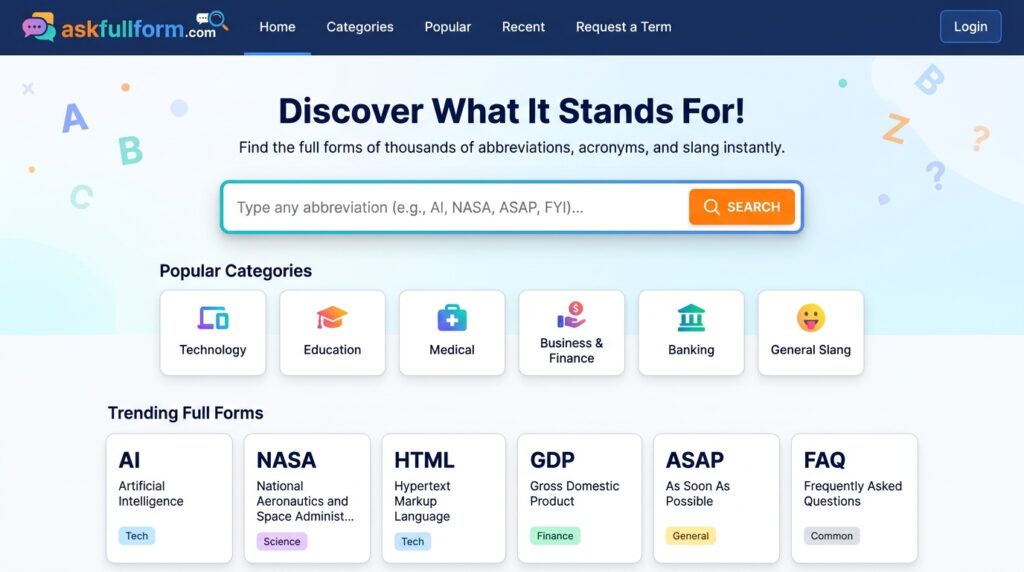

Understanding unfamiliar abbreviations, technical terms, and shortened expressions can make everyday learning challenging. AskFullForm.com is an informational website that helps readers explore full forms, definitions, and educational topics across different subject areas. It brings together information related to education, government, technology, business, finance, and general knowledge.
For students, professionals, and curious readers, understanding the meaning of unfamiliar terms is an important part of learning. A short abbreviation may represent an organization, examination, technical process, or professional concept. Knowing its full meaning can make information easier to understand and apply.
AskFullForm.com provides an online starting point for exploring these topics. This guide explains how the website works, what types of information readers can explore, and how to use online educational resources more effectively.
What Is AskFullForm.com?
AskFullForm.com is an online informational platform focused on full forms, abbreviations, definitions, and educational content. Its purpose is to make unfamiliar terminology easier to understand by providing explanations across multiple subjects.
Instead of limiting its content to simple abbreviation lists, the website also publishes broader informational articles. Readers can explore topics involving education, government organizations, business terminology, financial concepts, and modern technology.
For example, someone encountering an unfamiliar abbreviation in a document might want to know what the letters represent. However, understanding the expanded form is only the first step. The reader may also need information about its purpose, background, and practical application.
This is where explanatory educational content becomes valuable.
AskFullForm.com offers a place to begin that learning process by bringing different subjects together in an accessible online format.
Understanding Full Forms and Abbreviations
A full form is the expanded version of an abbreviated term. People use abbreviations to communicate more efficiently, particularly when discussing organizations, qualifications, technical subjects, and professional processes.
For example:
| Abbreviation | Full Form |
|---|---|
| ATM | Automated Teller Machine |
| CPU | Central Processing Unit |
| CEO | Chief Executive Officer |
| Portable Document Format | |
| HTML | HyperText Markup Language |
| FAQ | Frequently Asked Questions |
| USA | United States of America |
| AI | Artificial Intelligence |
These examples demonstrate how shortened expressions make written and spoken communication more convenient.
However, not every abbreviation has only one meaning. The same letters can represent different terms depending on the subject, industry, or country.
For instance, a three-letter abbreviation used in education may have an entirely different meaning in medicine or technology.
Therefore, readers should always consider the context in which an abbreviation appears rather than selecting the first available definition.
Main Topics Available on AskFullForm.com
One useful aspect of AskFullForm.com is its coverage of different informational categories. These subjects help readers explore terminology and broader topics according to their interests.
1. Education and Examination Information
Educational terminology can sometimes be confusing, especially for students preparing for examinations or completing academic applications.
Abbreviations frequently appear in examination notices, admission documents, study materials, and educational institutions.
Students may encounter terms related to:
- Examination boards and testing systems
- Academic qualifications
- Educational institutions
- Entrance examinations
- Courses and certifications
- Student admission procedures
Understanding these terms can help learners interpret academic information more confidently.
For example, a student researching an examination may need to understand its official abbreviation, eligibility terminology, and general purpose.
Online educational articles can provide an introductory explanation before the student consults the relevant institution for official requirements.
2. Government and Public Administration
Government-related abbreviations appear in official documents, public announcements, employment notices, and administrative information.
Readers may encounter terms connected with departments, public organizations, government programs, and administrative procedures.
Understanding these abbreviations can make official information easier to follow.
This category can be particularly helpful for people researching public institutions or learning about unfamiliar administrative terminology.
However, government policies and procedures can vary between countries and may change over time. Readers should verify important details through the relevant official government department.
3. Technology and Digital Terminology
Technology introduces new concepts and terminology across computers, software, artificial intelligence, internet services, and digital communication.
Some common examples include:
- AI: Artificial Intelligence
- API: Application Programming Interface
- URL: Uniform Resource Locator
- USB: Universal Serial Bus
- RAM: Random Access Memory
- SEO: Search Engine Optimization
Understanding these terms helps beginners follow technical discussions and learn how digital systems work.
Technology-related information is useful not only for students but also for professionals, business owners, and individuals interested in digital developments.
4. Business and Finance
Business and financial terminology is widely used in professional communication, accounting, banking, and everyday commercial activities.
Someone starting a business may encounter unfamiliar expressions in invoices, financial reports, payment documents, and business discussions.
Common terms include:
- ROI: Return on Investment
- CRM: Customer Relationship Management
- B2B: Business to Business
- B2C: Business to Consumer
- VAT: Value Added Tax
- HR: Human Resources
Learning these terms can improve basic business understanding and help readers communicate more effectively.
Financial terminology should always be interpreted according to its specific context and applicable country regulations.
5. Medical and Health Terminology
Medical abbreviations can appear in laboratory reports, prescriptions, hospital documents, and healthcare discussions.
Understanding basic medical terminology may help readers become more familiar with the language used in healthcare.
However, medical abbreviations can have multiple interpretations, and their meanings depend on clinical context.
Readers should never use a general online definition as a replacement for professional medical interpretation. Questions about diagnoses, test results, medications, or treatment should be discussed with a qualified healthcare professional.
6. General Knowledge and Everyday Information
Beyond specialized subjects, readers often search for meanings of common expressions used in communication, entertainment, education, and everyday activities.
General informational articles can help explain unfamiliar words, concepts, and terminology without requiring advanced subject knowledge.
This makes educational websites useful for people who want to expand their general knowledge at their own pace.
How to Use AskFullForm.com Effectively
Finding information online becomes easier when readers follow a simple process.
Here are some practical steps for using an informational website to understand unfamiliar terms.
Step 1: Identify the Unfamiliar Term
Start by identifying the abbreviation or expression you want to understand.
For example, you might encounter an unfamiliar term in an academic document, business report, online article, or technical discussion.
Write down the exact spelling because even a small difference can change the meaning.
Step 2: Search for the Term
Use the website’s available search functionality or browse the relevant category to locate an explanation.
Searching for the exact abbreviation can help narrow down the results.
If the term belongs to a particular industry, include that context when searching.
Step 3: Read the Complete Explanation
Do not stop after reading the expanded form.
Look for additional details explaining:
- What the term represents
- Where it is commonly used
- Why it is important
- Which industry or subject it belongs to
- Whether it has alternative meanings
This additional context helps prevent misunderstandings.
Step 4: Compare the Information With Its Context
Check whether the explanation matches the document, conversation, or subject where you found the abbreviation.
For example, an abbreviation appearing in a medical report should be interpreted according to medical terminology rather than an unrelated business definition.
Step 5: Verify Important Information
For information involving health, finance, education requirements, government policies, or legal matters, consult an appropriate authoritative source.
This final step is important because general educational articles may not include every recent change or specialized exception.
Who Can Benefit From AskFullForm.com?
Different readers can use full-form explanations and educational articles for different purposes.
Students and Learners
Students frequently encounter abbreviations in textbooks, examination materials, academic notices, and online learning resources.
Understanding these expressions can make studying easier and help learners become more familiar with subject-specific terminology.
Job Seekers
Employment advertisements often contain shortened terms related to qualifications, departments, experience, and professional responsibilities.
Learning their meanings can help applicants understand job descriptions and workplace communication.
Business Owners and Professionals
Business professionals regularly use abbreviations in reports, meetings, financial documents, marketing discussions, and customer communication.
Understanding common business terminology can make professional interactions more efficient.
Technology Enthusiasts
People interested in computers, artificial intelligence, software, and digital services can benefit from explanations of technical abbreviations.
These resources can help beginners develop a foundation before studying more advanced subjects.
General Internet Users
Not every search is connected to work or education.
Sometimes, people simply want to understand a word or abbreviation they encountered while browsing the internet, reading the news, or communicating with others.
A straightforward educational resource can help answer these everyday questions.
Why Context Matters When Searching for Full Forms
One of the most important things to understand about abbreviations is that their meanings are not always universal.
A group of letters may represent different expressions across industries and professional environments.
Consider the abbreviation PC. In everyday technology discussions, it commonly means Personal Computer. In other contexts, it can represent different terms.
This creates a common problem for people searching for full forms: finding an expanded version does not automatically mean it is the correct one.
To identify the appropriate meaning, consider these factors:
Subject area: Determine whether the abbreviation belongs to education, medicine, business, technology, or another field.
Document type: A laboratory report, employment notice, academic document, and financial statement may use different terminology.
Geographical context: Government organizations, qualifications, and administrative expressions may differ between countries.
Surrounding information: Read the complete sentence or paragraph to understand how the abbreviation is being used.
Using these checks can help readers select the most relevant explanation.
Benefits of Using Online Educational Resources
Online educational platforms have changed how people access basic information and learn unfamiliar concepts.
Instead of searching through multiple printed references, readers can use digital resources to explore definitions and introductory explanations.
Some practical benefits include:
Convenient Access to Information
Online articles can be accessed through internet-connected devices, allowing readers to explore information from different locations.
Easy-to-Understand Explanations
Well-written educational content can explain unfamiliar terminology in straightforward language.
This is especially helpful for beginners who may not understand advanced technical descriptions.
Coverage of Multiple Subjects
Websites offering different informational categories allow readers to explore several areas of knowledge in one place.
Independent Learning
Readers can explore topics according to their own interests and learning speed.
They can revisit explanations whenever they need clarification.
Improved Vocabulary
Regular exposure to new terminology can help readers develop a stronger vocabulary and become more comfortable with professional and academic language.
Things to Check Before Trusting Online Information
Not every online explanation is automatically accurate. Readers should develop good research habits when using informational websites.
Here are several important points to consider.
Check the Publication Date
Some topics change over time. Government procedures, educational requirements, financial information, and technical developments may become outdated.
Check whether the information reflects the current situation.
Understand the Author and Editorial Information
Look for available author details, editorial policies, and information about the website’s purpose.
Clear editorial information can help readers understand who is responsible for publishing the content.
Look for Clear Definitions
A useful explanation should clearly identify the meaning of a term and provide enough context to make it understandable.
Avoid relying on vague descriptions that do not explain how the terminology is used.
Verify Important Claims
Compare important information with official documents, recognized educational institutions, government departments, or relevant professional organizations.
This is especially important when an incorrect interpretation could affect a decision.
Understand the Limitations
An informational website is a learning resource, not necessarily an official authority.
Medical, financial, legal, and government-related information may require specialized verification.
AskFullForm.com Compared With Traditional Dictionaries
Traditional dictionaries generally focus on word meanings, spelling, pronunciation, and language usage.
Full-form websites have a different purpose. They concentrate on explaining abbreviations, shortened expressions, and terminology used in particular fields.
AskFullForm.com combines abbreviation-related information with broader educational and informational articles.
| Feature | Traditional Dictionary | Full-Form Information Website |
|---|---|---|
| Word definitions | Main focus | May be included |
| Abbreviation meanings | May be included | Main focus |
| Industry terminology | Varies | Common subject |
| Educational explanations | Depends on dictionary | Often included |
| General informational articles | Usually limited | May be available |
| Contextual examples | Varies | Depends on article |
Both formats can support learning.
The right resource depends on the question. A traditional dictionary may be more suitable for spelling and pronunciation, while a full-form resource may be more useful when exploring the meaning of an abbreviation.
Tips for Learning and Remembering New Abbreviations
Finding a full form is only the beginning. Remembering unfamiliar terminology can make it more useful in everyday situations.
Try these simple learning techniques:
- Create a personal vocabulary list: Record unfamiliar abbreviations along with their expanded meanings.
- Group related terms: Organize terminology into categories such as technology, business, education, and healthcare.
- Use practical examples: Write a sentence showing how each abbreviation is used.
- Review regularly: Revisit previously learned terms to improve recall.
- Understand the meaning: Focus on what a term represents instead of memorizing letters without context.
- Check alternative meanings: Record different definitions when an abbreviation is used across multiple industries.
These habits can gradually improve vocabulary, reading comprehension, and familiarity with professional terminology.
The Role of Full-Form Websites in Modern Learning
Digital learning has made educational information easier to access for people with different interests and experience levels.
Full-form websites contribute to this process by explaining terminology that readers may encounter in academic, professional, and everyday environments.
Their value is not limited to providing expanded abbreviations. A detailed explanation can also introduce a subject, describe how a term is used, and help readers identify related concepts.
For beginners, this can be a useful first step toward understanding a more complicated topic.
However, effective learning requires more than collecting definitions. Readers should compare information, understand context, and consult reliable specialist resources whenever necessary.
A balanced approach helps people use online educational content more confidently.
Frequently Asked Questions About AskFullForm.com
1. What is AskFullForm.com?
AskFullForm.com is an informational website that publishes full forms, abbreviation meanings, definitions, and educational articles across different subject areas.
2. What type of information can readers find on AskFullForm.com?
Readers can explore information related to education, examinations, government terminology, technology, business, finance, health, and general knowledge.
3. Is AskFullForm.com useful for students?
It can be useful as a supplementary learning resource. Students can explore unfamiliar abbreviations and introductory explanations, but should consult their educational institutions for official examination and admission requirements.
4. Can professionals use full-form websites?
Yes. Professionals can use abbreviation explanations to understand terminology appearing in business documents, technical discussions, workplace communication, and industry-related information.
5. Why can one abbreviation have multiple full forms?
Abbreviations are often reused across different industries and subjects. Their meanings depend on context, which is why readers should identify the relevant field before choosing an explanation.
6. How can I find the correct meaning of an abbreviation?
Search for the exact term, identify its subject area, read the surrounding explanation, and compare the result with the context in which the abbreviation appears.
7. Are online full-form websites official information sources?
Not necessarily. They can provide introductory explanations, but readers should verify important educational, legal, financial, government, and medical information through appropriate authoritative sources.
8. What is the difference between an abbreviation and an acronym?
An abbreviation is a shortened form of a word or phrase. An acronym is a type of abbreviation formed from initial letters and generally pronounced as a word, such as NASA.
Conclusion
AskFullForm.com provides an online starting point for readers interested in full forms, abbreviations, definitions, and educational information. Its coverage of education, government, technology, business, finance, and other subjects gives users different opportunities to explore unfamiliar terminology.
Students can use such resources to understand academic expressions, professionals can learn industry-related terms, and general readers can improve their knowledge of everyday abbreviations.
The most effective way to use any informational website is to look beyond the expanded meaning of a term. Understanding its context, checking the accuracy of explanations, and consulting authoritative resources when necessary are essential parts of responsible learning.
Whether you are exploring a new technical expression or trying to understand an unfamiliar abbreviation, developing good research habits can make online learning more productive.
Explore More: Cascade Natural Gas: A Practical Guide for Customers