
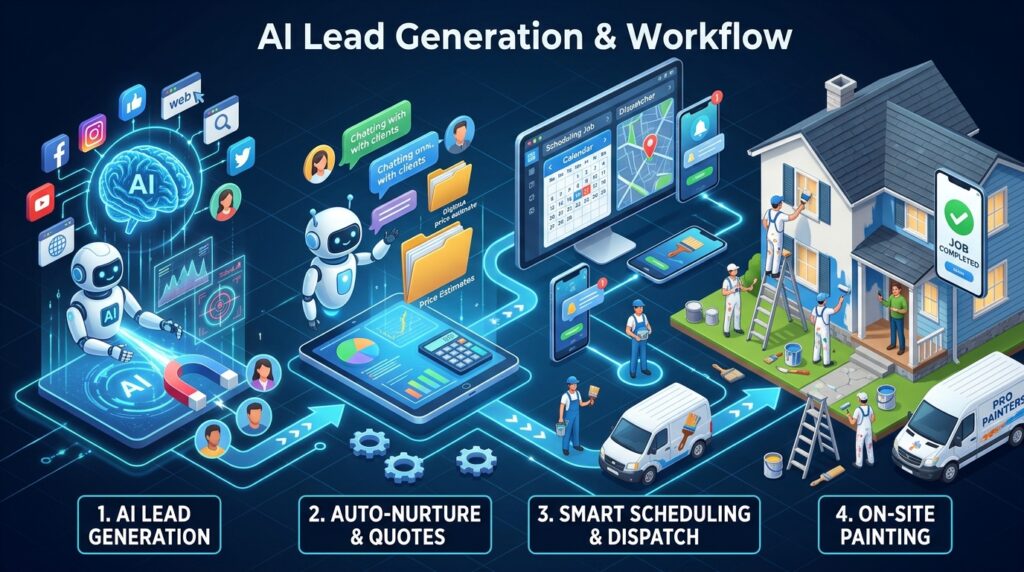

Running a painting business involves much more than choosing colors, preparing surfaces, and applying the perfect finish. Whether you operate a residential painting company, commercial painting service, or independent painting contractor business, finding new customers is essential for maintaining consistent revenue and long-term growth. However, managing inquiries, following up with potential clients, preparing estimates, and scheduling appointments can consume valuable time.
This is where AI lead generation automation can make a meaningful difference.
Artificial intelligence is changing how painting contractors attract prospects, communicate with homeowners, and convert inquiries into paying customers. By combining AI-powered tools with automated marketing systems, painting businesses can create an organized workflow that handles repetitive sales activities while allowing contractors to focus on delivering quality workmanship.
An effective AI lead generation automation workflow can capture inquiries from websites, social media platforms, online advertisements, and local search results. It can then organize customer information, respond to common questions, qualify potential projects, and help schedule estimates.
For painting trade businesses looking to increase their customer base, improve sales efficiency, and reduce administrative work, automation offers a practical opportunity to build a more predictable lead generation system.
What Is AI Lead Generation Automation for Painting Businesses?
AI lead generation automation refers to using artificial intelligence and automated software to identify, attract, collect, qualify, and manage potential customers.
For a painting contractor, this process begins when someone searches online for services such as interior painting, exterior house painting, cabinet refinishing, or commercial property painting.
Instead of relying entirely on manual communication, an automated system can manage several steps of the customer acquisition process.
For example, a homeowner visits a painting company’s website and completes a contact form requesting an exterior painting estimate. An AI-powered system can immediately collect the information, send an acknowledgment, ask relevant questions about the property, and notify the contractor about the new opportunity.
The system may also connect the inquiry to a customer relationship management platform, commonly known as a CRM, where the contractor can track the prospect through the sales process.
The main purpose is not to replace personal customer service. It is to make sure that fewer opportunities are missed and that every inquiry receives timely attention.
Why Painting Trade Businesses Need Automated Lead Generation
The painting industry is competitive, particularly in areas where homeowners and commercial property managers have several contractors to choose from.
A painting company may provide excellent services but still struggle to grow because potential customers are not receiving timely responses or consistent follow-ups.
Traditional lead management often creates several challenges.
1. Missed Customer Inquiries
Painting contractors frequently work on job sites, making it difficult to answer every phone call or website inquiry immediately.
When a potential customer does not receive a response, they may contact another painting company.
AI-powered lead capture and automated responses help acknowledge inquiries even when the business owner is unavailable.
2. Time-Consuming Follow-Ups
Some customers request estimates but take several days to make a decision. Without an organized follow-up process, contractors may forget to contact these prospects.
Automated reminders and personalized follow-up messages help maintain communication throughout the decision-making process.
3. Unqualified Leads
Not every inquiry represents a suitable painting project. Some customers may have unrealistic budgets, unclear requirements, or project locations outside the company’s service area.
AI lead qualification can help identify important details before the contractor spends time preparing an estimate.
4. Inconsistent Marketing Activities
Many small painting businesses depend on referrals and occasional social media posts. While these channels can generate customers, they may not provide a consistent flow of inquiries.
Combining local SEO, paid advertising, website forms, and automated communication creates a more structured marketing strategy.
5. Administrative Work
Responding to messages, organizing contact information, updating spreadsheets, and arranging appointments can take time away from actual painting work.
Automation reduces repetitive administrative tasks and creates a more efficient business operation.
How an AI-Powered Painting Business Lead Generation Workflow Works
A successful automation system should connect marketing, customer communication, lead qualification, appointment scheduling, and sales management.
Here is how the complete process can work.
Step 1: Attract Potential Customers Through Multiple Channels
The first stage is generating painting service leads from different online and offline sources.
A painting business can use several channels to attract homeowners, landlords, property managers, real estate professionals, and commercial clients.
Important lead generation channels include:
- Google Business Profile
- Local search engine optimization
- Painting service landing pages
- Google Ads
- Facebook and Instagram advertising
- Social media content
- Customer referral campaigns
- Email marketing
- Local business directories
- Partnerships with property management companies
For example, a painting contractor could create dedicated website pages targeting searches such as “interior painters near me,” “exterior house painting services,” and “commercial painting contractors.”
When potential customers discover these pages, they can submit an inquiry through a contact form or request an estimate.
AI-powered marketing tools can help analyze campaign performance, identify relevant keywords, and suggest improvements to advertising messages.
Step 2: Capture and Organize Incoming Leads
Once a potential customer expresses interest, the system should collect essential information.
A painting lead capture form can request:
- Customer name
- Phone number
- Email address
- Property location
- Type of painting service
- Residential or commercial project
- Estimated project size
- Preferred project timeline
- Additional project details
For example, someone interested in interior painting may select bedrooms, living rooms, kitchens, or an entire property.
The submitted information can automatically enter a CRM system.
This eliminates the need to manually copy customer details from emails, social media messages, and website forms into separate spreadsheets.
A centralized lead database also helps contractors maintain accurate customer records.
Step 3: Use AI Chatbots to Respond to Customer Inquiries
One of the most useful applications of artificial intelligence in painting businesses is automated customer communication.
An AI chatbot can answer common questions about painting services, service areas, working hours, estimate requests, and appointment availability.
For example, a website visitor might ask:
“Do you provide exterior house painting services?”
The chatbot can respond with relevant information about the company’s exterior painting services and guide the visitor toward requesting an estimate.
It can also ask follow-up questions such as:
- What type of property needs painting?
- Where is the property located?
- How many rooms or exterior surfaces require painting?
- When would you like the project to begin?
- Would you prefer an on-site estimate?
These conversations help collect useful project information before the contractor becomes involved.
However, automated systems should clearly communicate when a customer needs to speak with a real person. Complicated project questions, complaints, and detailed pricing discussions should be transferred to the appropriate team member.
Step 4: Qualify Painting Leads Automatically
Lead qualification helps painting contractors prioritize opportunities based on project suitability.
An AI-powered system can evaluate incoming inquiries using information such as location, service requirements, project size, estimated budget, and expected start date.
For example, consider three different inquiries:
Lead A: A homeowner needs a complete exterior painting project within the company’s service area and wants to begin within two weeks.
Lead B: A property owner wants a small interior painting job but has not decided when to proceed.
Lead C: A customer requests commercial painting services in a location outside the contractor’s service area.
The system can categorize these inquiries according to the business’s predefined requirements.
A simple classification system might include:
- High-priority lead: Strong service match and immediate project interest.
- Medium-priority lead: Suitable project with a flexible timeline.
- Low-priority lead: Incomplete information or limited project suitability.
This makes it easier to identify which prospects deserve immediate attention.
AI recommendations should support human judgment rather than make final decisions without appropriate review.
Step 5: Automate Painting Estimate Requests
Pricing is an important part of the customer journey.
Homeowners often contact multiple painting contractors before selecting a service provider. Providing a convenient estimate request process can improve the customer experience.
An automated system can collect project details and organize them for the estimator.
For example, it may request information about:
- Interior or exterior painting
- Approximate square footage
- Number of rooms
- Ceiling height
- Surface condition
- Existing paint condition
- Required preparation work
- Paint and finish preferences
- Accessibility requirements
Customers may also be invited to upload photographs of the areas requiring painting.
AI tools can help organize these details and identify missing information. Some systems can assist with preliminary estimates, but contractors should verify measurements, material requirements, labor costs, and site conditions before providing a final quotation.
This is particularly important because preparation, repairs, surface materials, and accessibility can significantly affect painting costs.
Step 6: Schedule Appointments Automatically
Once a lead is qualified, the next objective is arranging an estimate or consultation.
Appointment scheduling software can connect to a contractor’s calendar and display available time slots.
Customers can choose a convenient appointment without exchanging multiple emails or phone messages.
A typical automated scheduling workflow includes:
- The customer requests an estimate.
- The system checks the contractor’s available appointment slots.
- The customer selects a preferred time.
- A confirmation message is sent.
- A calendar event is created.
- An automatic reminder is delivered before the appointment.
This process reduces scheduling conflicts and helps contractors manage their daily workload.
For larger painting companies, scheduling automation can also help distribute appointments among different sales representatives or estimators.
Step 7: Build an Automated Follow-Up Sequence
Many painting leads do not become customers immediately.
A homeowner might request an estimate and then compare several contractors before making a decision. Consistent communication can help keep the business visible during this process.
An automated follow-up sequence may include:
Immediately after the inquiry: Send a confirmation message acknowledging the estimate request.
After one day: Ask whether the customer has any additional project details to share.
After the estimate: Send a polite message asking whether the customer has questions about the proposed work.
After several days: Provide helpful information about preparation, paint quality, scheduling, or project expectations.
Before the proposed start date: Confirm availability and discuss the next steps.
Messages should remain relevant, respectful, and personalized. Businesses should also follow applicable privacy and marketing communication regulations.
Essential AI Tools for Painting Business Automation
Choosing the right software is important because an overly complicated system can create unnecessary costs and administrative work.
A practical automation setup may combine several types of tools.
1. Customer Relationship Management Software
A CRM system stores customer details, tracks inquiries, and manages sales opportunities.
Painting contractors can use CRM software to organize leads according to their current status.
Popular platforms include HubSpot, Zoho CRM, and Salesforce.
A well-organized CRM can show which customers need a callback, which estimates are pending, and which projects have been approved.
2. AI Chatbot Software
AI chatbot tools help businesses respond to website inquiries and collect project information.
They can provide basic service details, answer frequently asked questions, and direct customers toward estimate requests.
The chatbot should use accurate company information and avoid promising prices, timelines, or services that have not been confirmed.
3. Workflow Automation Platforms
Automation platforms connect different business applications.
For example, Zapier and Make can connect website forms, CRM software, email platforms, and scheduling applications.
When someone submits a painting estimate request, the automation can create a CRM record, notify the business owner, and send an acknowledgment email.
4. Scheduling Software
Scheduling tools make it easier to coordinate consultations and on-site estimates.
Platforms such as Calendly can help customers select available appointment times.
This is especially useful for contractors who manage multiple projects and customer consultations.
5. Email and Communication Automation
Email marketing and communication tools help painting companies maintain contact with interested prospects.
Automated messages can provide estimate confirmations, appointment reminders, project preparation instructions, and follow-up communication.
The goal is to make communication more organized without making customers feel like they are interacting with an impersonal system.
A Practical Example of an Automated Painting Business Workflow
Consider a residential painting company that provides interior painting, exterior painting, and cabinet refinishing services.
The company receives inquiries through its website, Google Business Profile, and Facebook advertisements.
Without automation, the owner has to check each platform, respond to customers, collect project details, and arrange appointments manually.
With an AI-powered workflow, the process becomes more organized.
Stage 1: Lead Generation
A homeowner searches for interior painters in their local area and visits the company’s website.
Stage 2: Lead Capture
The homeowner completes an estimate request form and provides contact details, property location, and project requirements.
Stage 3: Automated Response
The system sends an acknowledgment and asks whether the homeowner needs painting for one room or the entire property.
Stage 4: Lead Qualification
The CRM categorizes the inquiry based on service area, project type, and timeline.
Stage 5: Estimate Preparation
The contractor receives the project information and reviews the requirements before arranging an on-site assessment.
Stage 6: Appointment Scheduling
The homeowner selects an available estimate appointment.
Stage 7: Follow-Up
After the estimate, the system sends a polite follow-up message to answer questions and maintain communication.
Stage 8: Customer Conversion
Once the homeowner approves the quotation, the company updates the lead status and moves the opportunity into its project management workflow.
Stage 9: Customer Retention
After the project is completed, the company requests feedback and invites the customer to recommend its services to others.
This workflow connects lead generation with customer management, creating a more consistent experience from the first inquiry to project completion.
How AI Can Improve Local SEO for Painting Contractors
Local search engine optimization is one of the most valuable long-term lead generation strategies for painting businesses.
Many homeowners search online when they need professional painting services in their neighborhood.
Search phrases may include:
- House painters near me
- Residential painting contractors
- Interior painting services
- Exterior house painters
- Commercial painting companies
- Cabinet painting specialists
- Affordable local painters
- Professional painting estimates
AI tools can help painting companies research these keywords, organize content ideas, and identify opportunities for improving website pages.
However, successful local SEO requires more than publishing AI-generated content.
Painting businesses should focus on:
Google Business Profile Optimization: Maintain accurate contact information, business hours, service categories, photographs, and service areas.
Location-Specific Service Pages: Create useful pages for the cities and neighborhoods the company genuinely serves.
Customer Reviews: Encourage satisfied customers to share honest feedback about their experience.
Project Photography: Publish original before-and-after photographs that demonstrate workmanship and project quality.
Helpful Website Content: Answer common questions about paint selection, surface preparation, project costs, and maintenance.
Consistent Business Information: Keep the company’s name, address, and phone number accurate across relevant directories.
AI can assist with keyword research and content planning, but genuine project experience and useful information remain essential for building search visibility.
Using AI to Improve Painting Lead Conversion Rates
Generating leads is only one part of growing a painting business. Converting those inquiries into confirmed projects is equally important.
AI can help contractors identify weaknesses in their sales process.
For example, a CRM system may reveal that customers frequently request estimates but rarely respond afterward.
The business can investigate whether its quotations are too complicated, response times are slow, or follow-up communication needs improvement.
AI-assisted analysis can also identify patterns such as:
- Which marketing channels generate the most qualified leads.
- Which painting services attract the highest customer interest.
- Which locations produce profitable projects.
- How long customers typically take to approve estimates.
- Which follow-up messages receive the most responses.
- Why potential customers decline quotations.
These insights can help painting companies make more informed marketing and sales decisions.
The most useful approach is to combine automated reporting with real customer feedback and business experience.
Common Mistakes to Avoid When Automating a Painting Business
Although AI automation offers several advantages, implementing the wrong system can create new problems.
Painting contractors should avoid the following mistakes.
Relying Completely on Automated Communication
Customers sometimes have detailed questions about paint products, surface damage, project preparation, and pricing.
An automated chatbot may not have enough information to provide accurate answers.
Always provide an easy way to speak with a real person.
Providing Unverified Painting Estimates
Automated estimate tools should not promise exact project prices without sufficient information.
Surface preparation, labor requirements, paint quality, and property conditions can affect the final cost.
Use automation to collect information, not to replace professional assessments.
Using Too Many Software Platforms
Connecting several unrelated applications can make the system difficult to manage.
Start with essential tools such as a CRM, lead capture form, and appointment scheduling software.
Add additional automation only when there is a clear business need.
Ignoring Customer Privacy
Painting businesses collect personal information, including names, addresses, phone numbers, and project details.
Customer information should be stored securely and handled according to applicable privacy requirements.
Only collect information necessary for the service and communication process.
Forgetting to Monitor Performance
Automation requires regular maintenance.
Businesses should review lead quality, response times, appointment bookings, conversion rates, and customer feedback.
An automated workflow is valuable only when it produces meaningful business improvements.
How to Implement AI Lead Generation Automation in Your Painting Business
A painting contractor does not need an expensive technology setup to begin using automation.
A gradual implementation strategy is often more practical.
Step 1: Identify Your Biggest Business Challenge
Determine whether the main problem is generating inquiries, responding to customers, organizing leads, or following up on estimates.
Step 2: Create a Reliable Lead Capture System
Build a website form that collects essential information about each painting project.
Step 3: Choose a CRM Platform
Select software that allows you to organize customer records, track opportunities, and manage follow-ups.
Step 4: Add Automated Communication
Set up confirmation messages and basic responses to frequently asked questions.
Step 5: Connect Appointment Scheduling
Allow qualified prospects to request estimate appointments through an organized scheduling system.
Step 6: Create a Follow-Up Process
Develop helpful follow-up messages for customers who have received estimates but have not yet made a decision.
Step 7: Track Results
Monitor how many inquiries become qualified leads, estimates, and confirmed painting projects.
Step 8: Improve the Workflow
Use actual performance data to identify problems and make adjustments.
Starting with a simple system helps prevent unnecessary expenses while giving the business room to grow.
Key Performance Indicators for AI Lead Generation
Tracking performance helps painting businesses understand whether their automation system is working.
Important key performance indicators include:
Total Leads: The number of new customer inquiries received during a specific period.
Lead Response Time: How quickly the business responds to incoming inquiries.
Qualified Lead Rate: The percentage of inquiries that meet the company’s project requirements.
Estimate Booking Rate: The percentage of leads that schedule a painting estimate.
Estimate Conversion Rate: The percentage of submitted estimates that become approved projects.
Customer Acquisition Cost: The average marketing and sales expense required to acquire a new customer.
Lead Source Performance: The number and quality of leads generated by different marketing channels.
Customer Retention Rate: The percentage of customers who return for additional services or projects.
These measurements provide a clearer understanding of marketing performance and help contractors decide where to invest their resources.
The Future of AI Automation in the Painting Industry
Artificial intelligence is expected to become increasingly useful for home improvement companies and painting contractors.
As AI tools become more sophisticated, businesses may gain access to improved customer communication, more advanced lead qualification, visual project assistance, and predictive sales insights.
Image analysis tools may help organize customer-uploaded photographs and identify visible surface concerns, although professional inspections will remain important for accurate assessments.
Voice assistants may also help businesses handle routine inquiries and direct callers toward estimate appointments.
Predictive analytics could help painting companies identify seasonal demand patterns, evaluate marketing performance, and plan staffing requirements.
However, technology will not replace the importance of craftsmanship, reliability, and customer relationships.
Homeowners still want painting contractors who arrive on time, communicate clearly, prepare surfaces properly, use suitable materials, and complete projects professionally.
The businesses that combine these qualities with efficient digital systems may be better positioned to compete in an increasingly technology-driven marketplace.
Frequently Asked Questions (FAQs)
1. What is AI lead generation automation for painting businesses?
AI lead generation automation uses artificial intelligence and connected software to attract potential customers, collect inquiries, qualify prospects, manage follow-ups, and support appointment scheduling for painting contractors.
2. How can AI help a painting contractor get more customers?
AI can support marketing campaigns, website chatbots, local SEO research, automated responses, lead qualification, and follow-up communication. These tools help businesses manage customer inquiries more efficiently and reduce missed opportunities.
3. Can AI automatically respond to painting service inquiries?
Yes. AI chatbots can answer common questions, collect project details, explain available services, and guide visitors toward requesting an estimate. Complex questions should be transferred to a human representative.
4. What is the best CRM for a painting business?
HubSpot CRM, Zoho CRM, and Salesforce are examples of platforms that can help painting businesses manage customer information and sales opportunities. The best option depends on company size, budget, and workflow requirements.
5. Can AI generate painting estimates?
AI tools can help organize project details and support preliminary estimates. However, contractors should verify measurements, labor requirements, materials, and surface conditions before providing a final quotation.
6. Is AI automation suitable for small painting contractors?
Yes. Independent contractors and small painting companies can benefit from simple automation, including website inquiry forms, automatic confirmations, appointment reminders, and customer follow-ups.
7. How does local SEO help painting businesses generate leads?
Local SEO improves a painting company’s visibility when nearby customers search for relevant services. Optimized service pages, accurate business listings, customer reviews, and useful website content can help attract potential customers.
8. How much does AI lead generation automation cost?
Costs depend on the software, number of integrations, business requirements, and automation complexity. Small contractors can begin with basic CRM and scheduling tools, then expand as their lead volume increases.
9. Can AI help painting companies follow up with customers?
Yes. Automated email and messaging workflows can send estimate confirmations, appointment reminders, and polite follow-up messages. Businesses should personalize communication and respect customer preferences.
10. Does AI replace salespeople in painting businesses?
No. AI can manage repetitive administrative activities and support customer communication, but professional contractors and sales representatives remain important for consultations, accurate estimates, negotiations, and building customer trust.
Conclusion
AI lead generation automation is becoming a practical solution for painting trade businesses that want to improve customer acquisition and streamline everyday operations.
From capturing website inquiries and qualifying prospects to scheduling estimates and managing follow-ups, automation can simplify several stages of the sales process.
The most effective strategy is to combine AI-powered tools with local SEO, a reliable CRM, professional communication, and strong customer service.
Painting contractors do not need to automate everything at once. Starting with a simple lead capture and follow-up workflow can already make customer management more organized.
As the business grows, additional tools can support appointment scheduling, marketing analysis, and sales management.
Ultimately, the goal of AI lead generation automation is straightforward: help painting businesses spend less time managing repetitive tasks and more time delivering excellent painting services, building customer relationships, and growing their companies.
Explore more: AI Agents for Business Zanus: Benefits and Uses


